The Helium atom displays a prototypical system for two interacting electrons (that are Spin-½). The two-electron Hamiltonian operator can be decomposed into two parts:
Where is the Hamiltonian operator of the independent electrons, while is the interaction term, describing the interaction between two electrons. can be written as the sum of one-electron Hamiltonian operators:
Where is a hydrogen type of Hamiltonian operator with (similar to the hydrogen atom, but double the central charge):
As we know from the hydrogen atom, the eigenstates of are labeled by the principal quantum number (associated with the energy of the system - and the radial part) , the angular momentum quantum number , the magnetic quantum number and the spin quantum number . So the wave function will become:
Ground state
The lowest energy one-particle states are the state:
In principle, we have to apply degenerate first-order degenerate time-independent perturbation theory, but the Coulomb interaction is independent of the spin and we work with orthonormal spin states, therefore, the matrix of the Coulomb interaction is diagonal on the basis . We then obtain the following energy corrections:
And for :
The triplet states are still degenerate, but the degeneracy between the triplet and singlet states is lifted. Let's see the meaning of the energy corrections:
The first two terms yield the classical Coulomb energy term:
But the other two terms have no classical analogues. Since they contain two different wavefunctions with the same coordinate argument, we call these terms the exchange integral:
Which gives the energy splitting between the singlet and triplet states,
For the investigation of the excited states of the helium atom we have to consider also the Slater determinants formed by the and states, because they are eigenfunctions of the unperturbed Hamiltonian with the same energy, . So, in principle, we have to work on a -dimensionalsubspace of two-fermion wave functions and employ first-order degenerate perturbation theory on this space. In order to avoid this high dimensional problem, we can make use of that the two-electron orbital angular momentum operator, , commutes with the Hamiltonian , so we can look for the eigenstates of the Hamiltonian being simultaneously common eigenstates of the operators and . Based on the addition of angular momenta, it is obvious that the states correspond to the two-electron orbital angular momentum quantum number , while the states correspond to . From the states related to , the valid two-electron states can be constructed as before:
Thus, they span a -dimensional subspace. Obviously, the matrix of is again diagonal and the degeneracies are lifted as above:
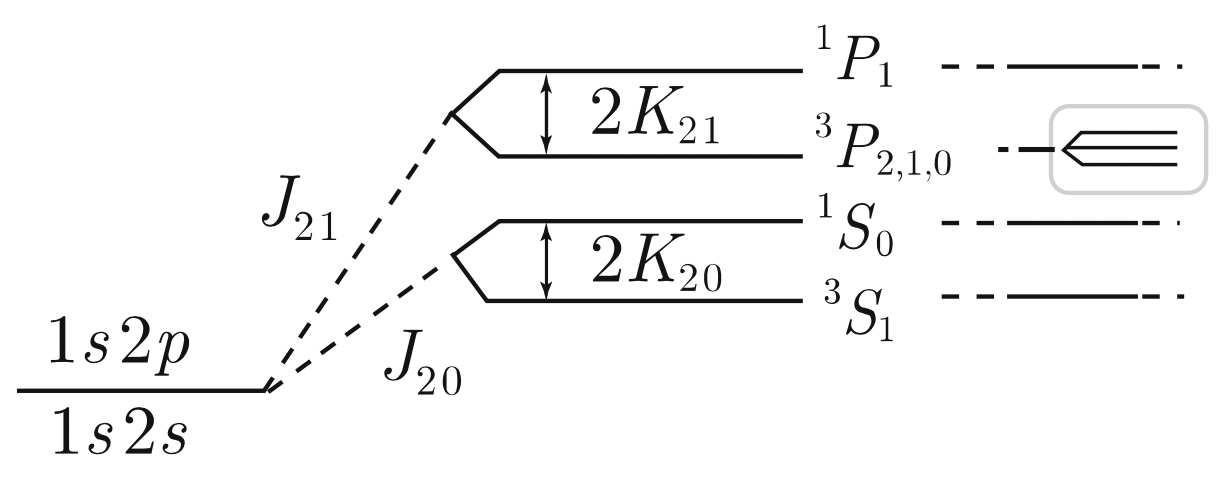
Where is the Coulomb integral and is the exchange integral as defined previously, but we of course have to replace by with . It is easy to show that the integrals and are independent of by symmetry. The tensor product space of the and states split them into four energy levels, as shown in the below figure:
Notations:
Comments about the extra splitting from spin-orbit coupling
For the description of the two-electron states of the atom, we use the notation , where with being the total angular momentum. Instead of we use the conventional notation , respectively. Due to the addition rules of angular momenta, for the singlet states , is unambiguously defined, . These levels are times degenerate. The states, or in other words, the and states can have , so this level is times degenerate. We can see that this level is going to split according to the three different values of due to spin-orbit coupling as noted on the figure.