Bloch's theorem

Metadata
aliases: []
shorthands: {"r": "\mathbf{r}", "Ur": "U(\mathbf{r})", "k": "\mathbf{k}", "kr": "\mathbf{k} \cdot \mathbf{r}", "ur": "u_{n\mathbf{k}}(\mathbf{r})", "T": "\hat{\mathbf{T}}"}
created: 2022-02-17 15:00:07
modified: 2022-02-23 00:33:58

Statement: In a periodic potential ,1 the solution to the Schrödinger equation takes the following form:

Where is the wave function, is the wave number vector. These states are called Bloch states with quantum numbers and 2. is a periodic function with the same periodicity as :

The Hamiltonian operator looks like this of course:

Where is the Laplace operator. The Bloch functions give a solution to :

Where is called the dispersion relation.

The quantum numbers

The eigenstates are described by two quantum numbers, and .

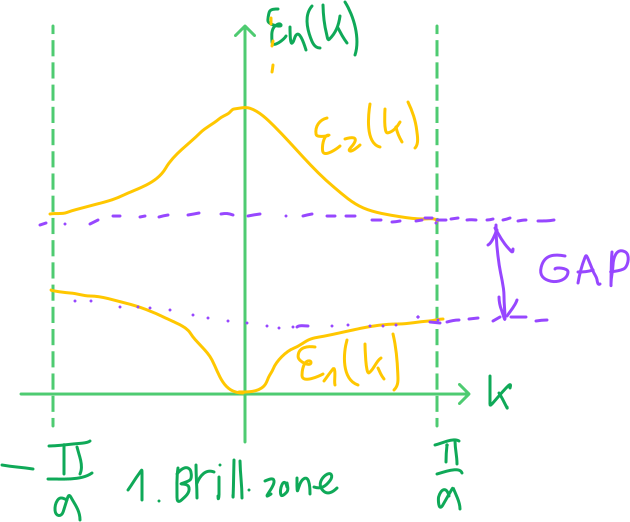
Band structure

Gaps show up between the different values of the energies these energies cannot be taken by any of the electrons in the system.

Since 3 the first Brillouin zone (in 1D from to where is the lattice constant) contains all the necessary information of the energy levels (band structure).

Proof

This proof will be done using operators. Let's first define the translation operator:

We can see that we only translate by lattice vectors, for which the potential is periodic to:

The Hamiltonian is the same as before. Since is invariant to translations, it should commute with the translation operator:

From this, we know that they have a common set of eigenfunctions.
Then we investigate the eigenfunctions of the translation operator:

It is easy to see that is additive:

This gives us the following for the eigenvalues:

This is satisfied by the following:

Where . And then applying the normalization condition over a single primitive cell of volume :

And then from this:

This means that:

Now it's easy to see that this is true for a Bloch wave when this is true:


  1. Here is an arbitrary lattice vector of the lattice that describes the periodicity of the potential.

  2. is not continuous due to the finite size of the investigated sample.

  3. Where is a lattice vector of the reciprocal lattice of the lattice that gives the periodicity of the potential.